
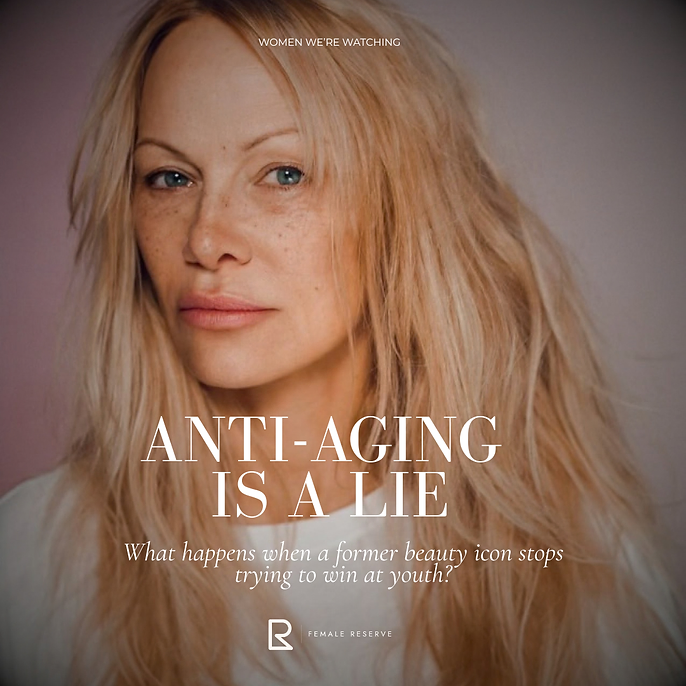
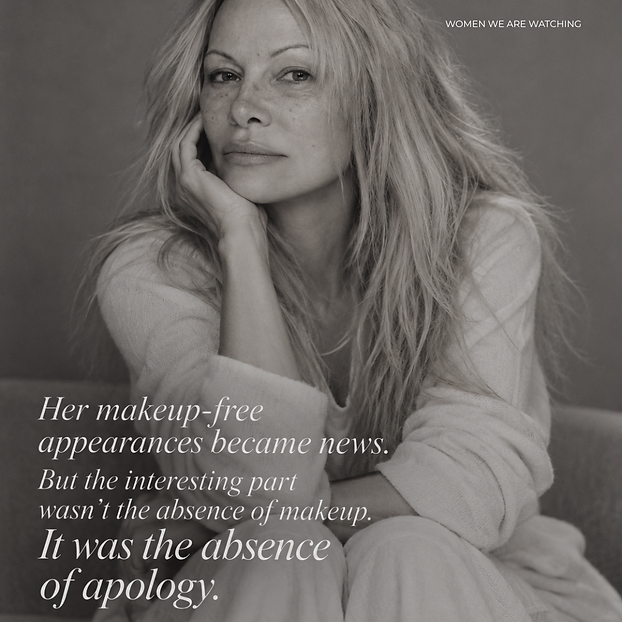
Pamela Anderson’s decision to appear at major fashion events with little or no makeup became news for a reason that had very little to do with makeup.
The woman underneath it had spent decades being turned into an image.
The bleached hair. The black liner. The narrow brows. The body. The red swimsuit. The entire visual language of Pamela Anderson eventually became larger than the person herself. Her beauty was not simply admired; it was reproduced, parodied, sexualized, copied, monetized and turned into shorthand for a particular kind of hyper-femininity.
So when Anderson arrived at Paris Fashion Week in 2023 with a bare face, people treated it almost like a transformation.
It wasn’t really.
Her face was still there.
What had disappeared was the performance around it.
And that may be why the reaction was so revealing.
For women who have spent decades being told that beauty requires increasing intervention as they age, the sight of a famous woman doing less can feel strangely confrontational.
Especially when that woman was once famous for doing more.
The woman was always underneath the image
Anderson has resisted turning her makeup-free appearances into another beauty doctrine.
She has said repeatedly that she is not against makeup. She still likes it. She considers it a form of expression. She even returned to a very recognizably 90s beauty world for a Smashbox campaign.
What seems to have changed is not makeup itself.
It is the obligation.
Talking to Glamour in 2024, Anderson described makeup as a form of communication, while also saying she was increasingly amused by the visible changes of aging—loss of elasticity, freckles changing—and had stopped treating them as something that required panic. Then came the line that makes her current beauty philosophy much more interesting than a simple “no makeup” story:
“Anti-aging is a lie.”
“We’re getting older no matter what,” she continued. “Things change.” (Glamour UK)
Later that year, she described the choice facing women in midlife even more plainly: do you chase youth and become miserable, or practice some form of self-acceptance? (Glamour UK)
That is a much bigger question than whether or not to wear mascara.

Because beauty and youth were never actually synonyms
The beauty economy has spent decades allowing the two ideas to collapse into each other.
Beautiful skin becomes young-looking skin.
A successful face becomes a face on which time is difficult to detect.
Aging “well” becomes aging invisibly.
And an enormous commercial infrastructure exists to help women participate in that project.
There is nothing inherently wrong with any of it.
Botox can be enjoyable. Makeup can be pleasurable. Lasers can improve skin. Retinoids work. Hair colour can make someone feel more like herself. Cosmetic procedures do not automatically represent insecurity any more than lipstick does.
But there is a meaningful difference between choosing to alter something and believing that visible aging represents a failure to maintain yourself correctly.
That distinction becomes particularly important in midlife.
Because by then, the work can become endless.
The face changes with declining collagen and elastin, cumulative UV exposure, shifts in bone and fat compartments and, for women, hormonal changes across the menopausal transition. Hair changes. Pigmentation changes. Skin becomes thinner and often drier. Soft tissue distribution changes.
These are biological processes.
They are not evidence that someone has stopped trying.
And refusing to acknowledge that difference creates a peculiar kind of trap: women can spend enormous amounts of time and money preserving an earlier version of themselves without ever stopping to ask whether that is the version they actually want to keep performing.
Pamela Anderson is interesting because she had more to lose
A woman who was never particularly associated with glamour deciding to go makeup-free would probably not have produced hundreds of headlines.
Anderson did.
Her appearance was part of the product.
That is why her choice carries cultural weight.
She had spent decades inside one of the most demanding beauty identities imaginable. The highly constructed Pamela—the hair, lashes, liner, body, sexuality—was not merely a look. It was public property.
In a 2024 Glamour profile, Anderson described her earlier beauty persona almost as a costume and spoke about peeling back layers to find the person underneath. She also said that, in her fifties, she felt more comfortable in her skin than she had in decades. (Glamour UK)
This is where the story becomes more interesting than “celebrity embraces natural beauty.”
Because she has not become anti-beauty.
She has launched herself into skincare. She still enjoys clothes. She still photographs beautifully. She still participates in fashion. She still understands the pleasure of transformation.
She has simply stopped behaving as though every transformation must move in the direction of younger.
Vogue described her new minimalist beauty period as rooted in self-acceptance, and Anderson herself said she had no glam team with her at the 2023 Fashion Awards: she was “keeping it simple.” (Vogue)
That simplicity is not the absence of beauty.
It is a different relationship with it.

There is an important distinction here for Female Reserve
Female Reserve is deeply interested in preservation.
But preservation needs a definition.
We want women to preserve muscle because muscle matters for mobility, metabolism, bone health and independence.
We want women to preserve cardiovascular capacity.
Cognitive function.
Bone.
Metabolic resilience.
Sexual health.
Sleep.
Strength.
The ability to travel, work, think clearly, move freely, live independently and participate fully in life for as long as possible.
Skin health belongs in that conversation too.
But skin health and the demand to remain visually young are not the same project.
Protecting skin from UV damage is health.
Treating skin disease is health.
Supporting the skin barrier is health.
Improving pigmentation or texture because you want to can be pleasure, aesthetics or self-expression.
But erasing every visible marker of time is something else.
Female longevity should be careful not to inherit one of the beauty industry’s oldest mistakes: confusing preservation with stasis.
A healthy 60-year-old woman does not need to resemble her 35-year-old self for the intervention to have worked.
Perhaps this is the freedom Anderson is really modeling
Not the freedom to stop caring how you look.
That interpretation is too easy.
And probably inaccurate.
The more interesting freedom is being allowed to care about beauty without making youth the only possible outcome.
To wear makeup one day and none the next.
To improve your skin without pretending it has not aged.
To enjoy vanity without turning your own face into an adversary.
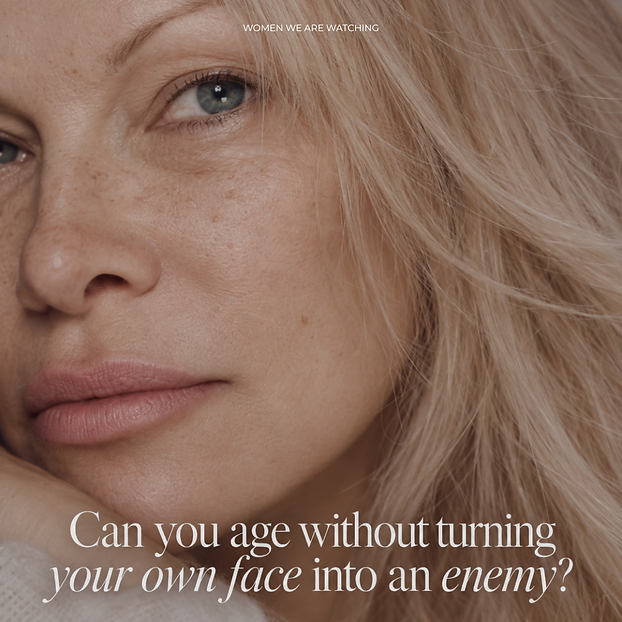

To see a line, a freckle, a change in texture and not immediately translate it into a problem that requires solving.
Anderson has been careful about this. She has said she is not trying to create a movement or dictate what other women should do. Her decision was personal. She was “doing it for myself.” (Glamour UK)
That may be exactly why it resonated.
Women already have enough instructions.
What to inject.
What to lift.
What to prevent.
What to optimize.
What age they should look.
What age they are allowed to admit they are.
The radical part may simply be deciding which instructions still belong to you.
Beauty can remain.
Pleasure can remain.
Makeup can remain.
Vanity can remain.
Intervention can remain.
But the enemy does not have to be your age.
Female Reserve perspective: Protect what matters. Do not confuse preservation with pretending nothing changes.
Taylor Walder — Writer & Editor, Female Reserve Journal
Part of the framework
Protect →The weekly briefing
Understand the system. Protect your Reserve.
One email on female healthspan, evidence states included.
Join The Reserve →Female Reserve provides education, not medical diagnosis or treatment.