
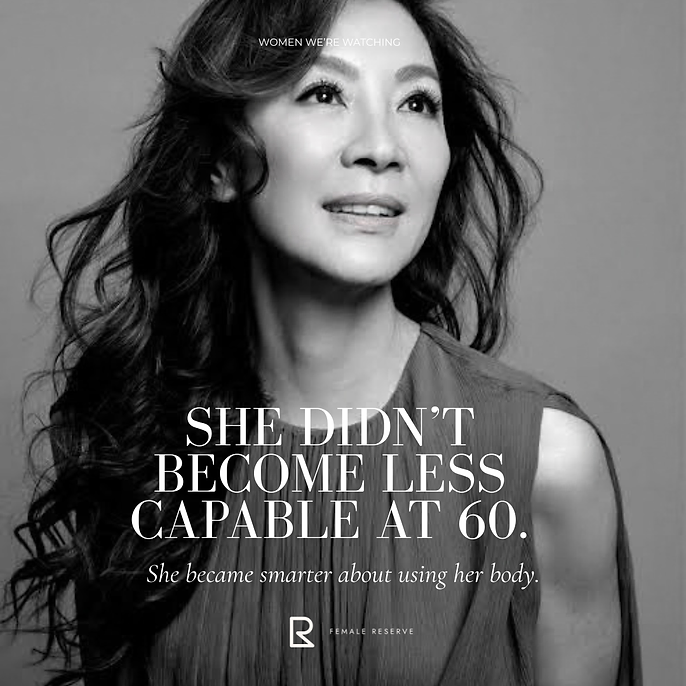
At 60, Michelle Yeoh was asked a question women are rarely allowed to answer without first apologizing for their age.
Could she still do the physical work?
The assumption underneath it was familiar. A woman no longer looks as she did at 25, therefore she must be less physically capable than she was at 25.
Yeoh’s answer was much more interesting.
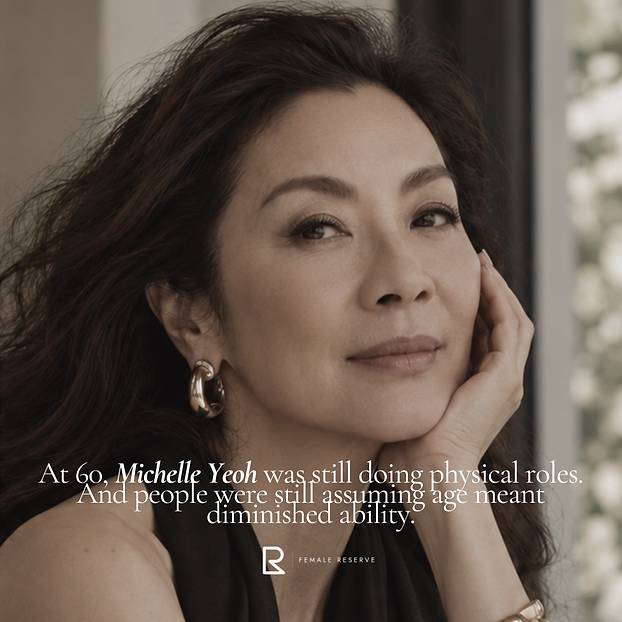
She did not pretend age was irrelevant. She said she had learned more. She understood her body better. She managed her stamina differently. She knew how to take care of herself in ways she had not when she was younger. In a 2022 interview with the Los Angeles Times, she pushed back on the idea that age automatically meant diminished ability. What she had lost in youth, she had partly replaced with experience, preparation and a far better understanding of her own limits.
That sounds like a career answer.
It is also a very good healthspan answer.
We have confused youth with capability
Modern longevity culture often speaks about aging as if the objective is to preserve the youngest possible version of ourselves for the longest possible time.
- Maintain the biomarkers.
- Maintain the body fat.
- Maintain the skin.
- Maintain the hormone profile.
- Maintain the biological age.
The framing is seductive because youth gives us an easy visual shorthand for health.
But youth and capability are not the same thing.
A 25-year-old can be weak.
A 40-year-old can be metabolically unwell.
A 65-year-old can have extraordinary cardiovascular fitness, balance and strength.
Chronological age matters. Biology changes. Recovery changes. Muscle becomes harder to preserve. Bone loss accelerates in women after menopause. Aerobic capacity tends to decline. Injury history accumulates.
None of that should be romanticized away.
But capability is not produced by chronological age alone.
It is produced by a much larger system.
- Strength.
- Training history.
- Cardiorespiratory fitness.
- Mobility.
- Balance.
- Sleep.
- Nutrition.
- Recovery.
- Past injury.
- Hormonal status.
- Disease burden.
- Stress.
And something longevity conversations sometimes undervalue: experience.
An older body is not simply a younger body with things missing
That distinction matters.
A woman in her fifties may recover more slowly than she did at 25 and still train much more intelligently.
She may have less tolerance for chaos but a better understanding of sleep.
She may have lost some raw explosiveness and gained decades of motor skill.
She may know how to recognize an injury before it becomes one.
She may understand exactly how much she can push, when she needs to stop and what her body requires afterward.
In other words, age does not only remove.
It also teaches.
That does not cancel biological decline. But it changes the equation.

Yeoh’s career makes that visible in an unusually literal way.
She became internationally famous for the physicality of her work. She has performed martial-arts-heavy roles, sustained injuries and built a career in an industry that historically treated action as a young man’s domain.
Then, at an age when actresses are often pushed toward quieter roles, she became the physical center of Everything Everywhere All at Once.
The interesting part was not that she moved exactly as she had decades earlier.
She didn’t need to.
Capability had changed form.
This is the healthspan question hiding underneath longevity
Healthspan is often described as the number of years lived free from significant disease or disability.
Useful definition.
But for an individual woman, it becomes much more tangible when turned into verbs.
- Can you lift?
- Can you carry?
- Can you climb stairs?
- Can you get off the floor?
- Can you react quickly enough to catch yourself?
- Can you travel without the trip exhausting you for three days afterward?
- Can you play with your children or grandchildren?
- Can you keep working if you want to?
- Can you have sex comfortably?
- Can you live alone?
- Can you recover from surgery, infection or injury without losing months of function?
These are not cosmetic questions.
They are capability questions.
And they are exactly where the difference between lifespan and healthspan becomes visible.
Living longer is one achievement.
Remaining physically and cognitively able to participate in your life is another.
Women have particular reasons to think about capability early
For women, the conversation becomes especially important in midlife.
The menopausal transition is associated with biological changes that can affect several systems relevant to future function: body composition, bone density, cardiovascular risk, sleep and muscle.
Again, the point is not that menopause suddenly makes a woman incapable.
The point is that this is a period when the inputs that protect future capability deserve more attention.
- Resistance training.
- Protein.
- Bone health.
- Cardiovascular fitness.
- Balance.
- Recovery.
- Sleep.
- Metabolic health.
There is a reason muscle has become such a central part of longevity medicine.
It is not because everyone needs to become a bodybuilder.
Muscle is reserve.
It gives the body somewhere to draw from during illness, injury and aging.
Strength protects independence.
Cardiorespiratory capacity protects much more than the ability to run.
Balance protects against falls.
Mobility keeps movement available.
The body needs margin.
The problem with “anti-aging”
When longevity is framed primarily as remaining young, women receive a strangely distorted message.
The face becomes evidence.
The waist becomes evidence.
The gray hair becomes evidence.
Every visible marker of age becomes something that can be interpreted as biological failure.
But a woman can look older and become stronger.
She can have wrinkles and improve her VO₂ max.
She can enter menopause and deadlift more than she did at 35.
She can lose facial volume while gaining metabolic health.
She can have gray hair and better balance, better blood pressure, more muscle and a much clearer understanding of her own body.
Those things can coexist.
That is why the language matters.
Preservation does not have to mean preservation of youth.
It can mean preservation of function.
Michelle Yeoh offers a more useful aspiration
There is something refreshing about Yeoh’s answer because it does not require fantasy.
She did not say nothing changes.
She said she changed with it.
She became more strategic.
More aware.
Better at managing stamina.
Better at caring for the body she actually had.
That is a much more compelling model of aging than the idea that success means appearing untouched by time.
Because the goal is not to freeze a 25-year-old body in place.
The goal is to build enough physical reserve that the body remains useful to you.
At 40.
At 50.
At 60.
At 70.
At 80.
Not identical.
Capable.
And perhaps that is the more interesting longevity question for women.
Not:
How young can I stay?
But:
What do I want to remain capable of doing?
Then build for that.
Female Reserve perspective: Youth is temporary. Capability can be trained, protected and extended.
Taylor Walder — Writer & Editor, Female Reserve Journal
Part of the framework
Protect →Join the list
Understand the system. Protect your Reserve.
Occasional emails about what we are building.
Join the list →Female Reserve provides education, not medical diagnosis or treatment.