

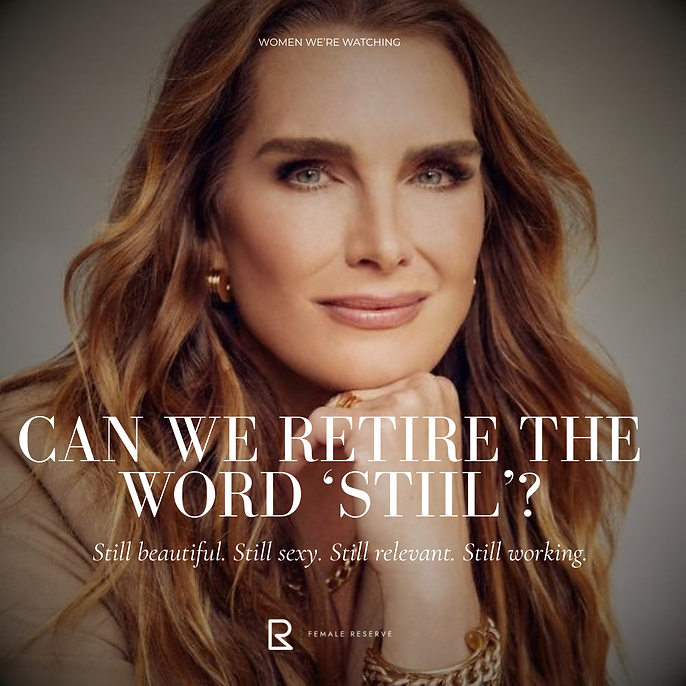
Brooke Shields has spent almost her entire life being evaluated visually. Now, in middle age, she is questioning one of the strangest words we use around women after 40: still.
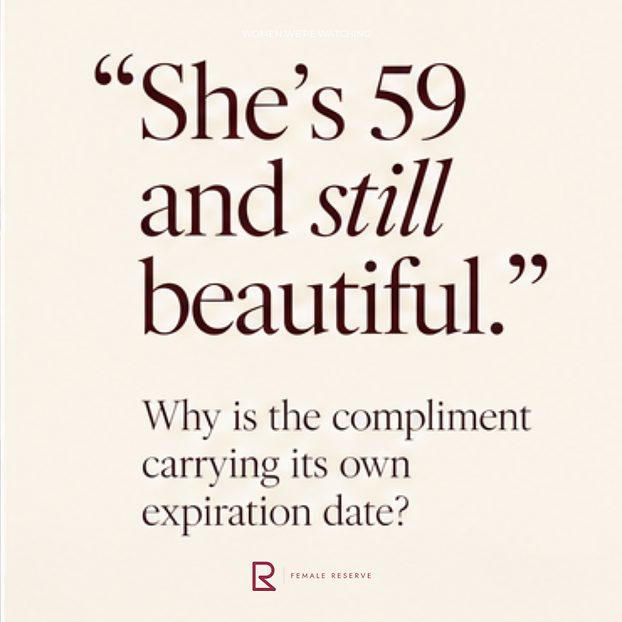
There is a particular compliment women begin to receive after a certain age.
“You’re still beautiful.”
Still.
As though beauty had an expiration date and someone had been generous enough to extend it.
Brooke Shields has heard versions of this for years.
In a 2024 interview with Allure, Shields described people telling her, “You’re still beautiful,” and asking, essentially, what the word was doing there in the first place. She also pointed to another version of the same phenomenon: people telling her daughters that their mother “used to be so beautiful.” Allure
It sounds minor.
It isn’t.
Because “still” is rarely neutral when we attach it to women in middle age.
- Still beautiful.
- Still sexy.
- Still ambitious.
- Still working.
- Still relevant.
- Still wearing that.
- Still dating.
- Still interested in sex.
- Still strong.
- Still visible.
The word quietly introduces decline before decline has necessarily occurred.
It turns an ordinary characteristic into an exception.
And once you notice it, you hear it everywhere.

Brooke Shields knows what it means to age under observation
Shields has an unusually intimate relationship with the politics of appearance.
She began modeling as a baby. By adolescence, her face had become part of the cultural landscape. In 1981, Time called hers “the face of the decade.” Much of her early career was built around other people looking at her, interpreting her and deciding what her appearance meant. Allure
That history matters.
When a woman who has spent most of her life being evaluated visually says she wants to rewrite the language of aging, she is not speaking theoretically.
She knows what happens when appearance becomes currency.
She also knows what happens when the culture decides that currency should depreciate with age.
In the same Allure interview, Shields argued that women over 40 are routinely assigned a narrow vocabulary: “aging,” “dry,” “menopause.” Her objection was not that these things are unreal. It was that they had become almost the entire story. Allure
Her preferred vocabulary was different.
- Experience.
- Strength.
- Humor.
- Confidence.
- Versatility.
- Vitality.
That is a much more interesting middle-age lexicon.
The problem with “still” is that it assumes surprise
Language does not simply describe reality.
It also tells us what reality we were expecting.
Consider the difference between these two sentences:
She is beautiful.
She is still beautiful.
The factual content is almost identical.
The expectation is not.
The second sentence implies that beauty should probably have diminished by now.
The same is true of ambition.
“She is still ambitious.”
Why wouldn’t she be?
Or sexuality.
“She still cares about sex.”
Why is desire treated as something that requires an explanation after 45?
Or visibility.
“She still gets invited.”
Or work.
“She’s still going.”
At some point, the language stops describing a woman and starts grading her resistance to disappearance.
That is what Shields is pushing against.
And it is one reason this conversation belongs inside Female Reserve.
Because the environment women age inside matters.
Not only biologically.
- Psychologically.
- Socially.
- Commercially.
- Culturally.
Women do not age in a vacuum
Female aging is often discussed as though it were purely physiological.
Hormones change.
Body composition shifts.
Skin changes.
Sleep changes.
Bone density changes.
Muscle becomes harder to preserve.
Cardiovascular risk changes.
Those things matter.
But women are also aging inside a culture that constantly narrates what those changes are supposed to mean.
If strength after 50 is framed as surprising, women absorb that expectation.
If ambition after 50 is treated as unusual, women absorb that too.
If sexuality after menopause is treated as niche, embarrassing or exceptional, the social environment begins to shape what women imagine is possible for themselves.
There is a difference between biological change and cultural prediction.
We are interested in that distinction.
Because prediction can become behavior.
A woman who expects weakness may train less.
A woman who expects sexual decline may stop asking questions about discomfort, libido or treatment.
A woman who expects invisibility may withdraw from work, style, dating or public life before she actually wants to.
A woman who believes middle age is essentially a waiting room may begin living accordingly.
The body ages.
But so do expectations.
And expectations can be trained too.
Shields built a business around the gap
This is not only an idea Shields discusses in interviews.
She turned it into a business.
After building an online community for women over 40, Shields launched Commence, a hair-care company specifically designed around the changing scalp and hair needs of women in midlife. She has said the idea emerged from conversations with women over 40 who repeatedly raised concerns about thinning, dryness, scalp health and other changes. Allure
The interesting part is how deliberately she avoided framing those women as depleted.
Commence’s own language is aimed at women over 40 whose “best hair—and their most exciting new beginnings—lie ahead.” Commence
That sentence matters more than it appears to.
It reverses the standard chronology.
Most beauty marketing says:
Your best was then.
Here is something that might help you preserve it.
This says:
Your next chapter may contain things you have not reached yet.
It is a completely different emotional proposition.
And it reveals why language is not cosmetic.
It is strategic.
Middle age does not need to be rebranded as youth
There is one trap worth avoiding here.
The answer to ageist language is not to insist that 50 is “the new 30.”
That only preserves the same hierarchy.
Thirty remains the ideal.
Fifty becomes acceptable only if it can successfully impersonate it.
Female Reserve is interested in something more useful.
What if 50 is simply 50?
What if 60 does not need to borrow legitimacy from 40?
What if the goal is not to prove that aging women are secretly young?
What if they are allowed to be older and powerful at the same time?
That sounds obvious.
Culturally, it is not.
Shields herself has resisted the phrase “aging gracefully.” In Allure, she questioned why women are expected to make aging look elegant in the first place, while also acknowledging that acceptance does not mean passivity. She is open about hair dye, skincare and appearance. She has discussed Botox and cosmetic procedures without pretending women should either reject them or submit to them. Allure
That nuance matters.
She is not arguing that women should stop caring about beauty.
She is arguing against making aging itself a failure condition.
The over-40 years are not an epilogue
In 2025, Shields released a memoir with a deliberately provocative title: Brooke Shields Is Not Allowed to Get Old.
When asked about the book, she described one of the biggest misconceptions about women’s aging as the idea that after a certain age, women have “had a good run” and are essentially put out to pasture. She described the years after 40 as a period women should feel entitled to inhabit fully, rather than apologize for reaching. Good Morning America
That phrase—“had a good run”—captures the problem perfectly.
It is farewell language.
Used far too early.
And that is where the word “still” belongs too.
Still implies that the main event is over.
What comes afterward is bonus time.
But women in their forties, fifties and sixties are not living in an extended epilogue.
They are starting businesses.
Changing careers.
Raising children.
Watching children leave home.
Falling in love.
Leaving marriages.
Training.
Traveling.
Leading companies.
Writing books.
Having sex.
Losing parents.
Making money.
Making mistakes.
Beginning again.
None of those things require the word “still.”
Female Reserve is interested in language because language becomes infrastructure
The longevity conversation often focuses on measurable inputs.
- Protein.
- Resistance training.
- Sleep.
- Glucose.
- VO₂ max.
- Hormones.
- Bone density.
Those matter.
But there is also a softer infrastructure around aging.
What women believe is available to them.
What they expect their bodies to be able to do.
What they believe is appropriate to want.
What they think they are permitted to begin.
That infrastructure is partly built through language.
If a culture repeatedly tells women they are unusually beautiful for their age, unusually strong for their age, unusually sexy for their age, unusually ambitious for their age, then “for their age” eventually becomes the ceiling.
Shields’ objection to “still” is useful because it exposes that ceiling in miniature.
The word sounds complimentary.
But underneath it is surprise.
And underneath the surprise is expectation.
Maybe we should change the expectation.
Maybe she is not still beautiful.
She is beautiful.
Maybe she is not still ambitious.
She is ambitious.
Maybe she is not still relevant.
She is relevant.
Maybe she does not still want more from her life.
She wants more from her life.
No disclaimer required.


Female Reserve perspective: Language shapes the future women imagine for themselves. Aging should describe time passing, not automatically prescribe disappearance.
Taylor Walder — Writer & Editor, Female Reserve Edit
Related articles
Join the list
Understand the system. Protect your Reserve.
Occasional emails about what we are building.
Join the list →Female Reserve provides education, not medical diagnosis or treatment.